Rapid Crop Treatment: Making Every Spray Hour Count
There is a moment in late spring when the whole season seems to hang on a weather window. The crop is at the right growth stage, the pest or disease pressure is building, and the forecast gives you maybe two dry days. That is when the difference between a good year and a mediocre one often comes down to speed. Getting a treatment out quickly, accurately, and without damaging the crop is not just about convenience. It is about protecting yield and making sure the inputs you have already invested in actually pay off.
For a long time, rapid crop treatment meant running a tractor through the field as fast as the conditions allowed, hoping the boom sprayer kept up and the wheels did not flatten too many plants. That approach still works, but it has limits. Wet ground, tall crops, and narrow tramlines can slow everything down. The pressure to cover ground quickly can lead to skips, overlaps, and spray drift. In a season where every day counts, those compromises cost money.
The Shift to Aerial Application
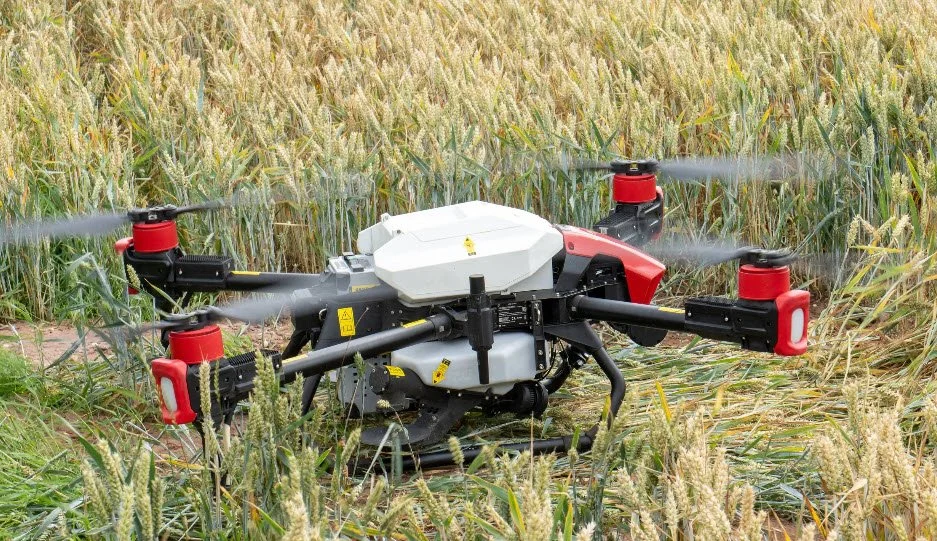
Agricultural drones have changed how many growers think about timing. A machine like the DJI Agras can be on site within minutes, fly a pre-planned route, and treat a field while the soil is still too wet for a tractor. That is the real advantage: not just speed in the air, but speed from the moment you decide an application is needed. You are not waiting for the ground to dry out or for a contractor to have a gap in their schedule.
This is especially useful in arable farming, where disease and pest pressure can move quickly through a crop. If you spot the first signs of rust or septoria, you want to act before it spreads. A drone can be programmed and launched while the agronomist is still writing the recommendation. That kind of response time was hard to imagine ten years ago.
Precision Matters as Much as Speed
Going fast is only useful if the treatment goes where it is supposed to go. That is where precision agriculture comes in. GPS-guided spraying means the drone follows the same line every pass, with minimal overlap and no gaps. The result is a more even application, which matters for both crop protection products and fertiliser spreading.
With variable rate application, the drone can adjust the amount of product based on a prescription map. That map might come from soil analysis, yield mapping, or NDVI imagery taken a few days earlier. Instead of treating the whole field the same, you put more where the crop needs it and less where it does not. That approach saves money on agrochemicals and biostimulants, and it reduces the risk of over-application. It also tends to produce more uniform crop growth, which makes harvest easier and often lifts yields.
For seed drilling, drones offer a different kind of precision. Sowing into standing stubble or a cover crop can be done without disturbing the soil, which helps with moisture retention and weed control. The accuracy of the seed placement is good enough for many catch crops and even some main crops, especially where a conventional drill would struggle with wet conditions.
What Rapid Crop Treatment Really Requires
Rapid crop treatment is not just about having a fast machine. It is about having the right data, the right product, and the right timing. If you do not know where the problem is, you cannot treat it precisely. That is why remote sensing has become such an important part of the workflow. Aerial imagery, whether from satellites or drones, can show stress patterns that are not visible from the ground. By the time you see the yellowing or the leaf spots, the problem has often been developing for days.
Using NDVI imagery, you can create a vegetation index map that highlights areas of poor growth. That map can be used to guide scouting, so you are not walking the whole field looking for trouble. It can also feed directly into a variable rate application map. This is where the practical experience of a good agronomist still matters. The technology tells you where the differences are, but the agronomist decides what is causing them and what to do about it.
For example, a patch of low NDVI might be caused by a nutrient deficiency, a soil compaction issue, or a developing disease. Treating it with a fungicide would be wrong if the real problem is nitrogen. The drone is only the delivery system. The thinking still has to come from a person who understands the crop and the field history.
Practical Considerations for Drone Spraying
There are practical details that make drone spraying work well. The first is calibration. A drone sprayer needs to be set up correctly for the product being applied, the droplet size required, and the weather conditions. Too fine a droplet and you risk drift. Too coarse and you might not get good coverage. The DJI Agras systems allow for precise control of flow rate and droplet size, but the operator still has to make the right choices.
Another consideration is battery life and logistics. A single drone flight might cover a few hectares before the battery needs changing or the tank needs refilling. For larger fields, that means having a support vehicle with spare batteries and a mixing station. The speed advantage comes from the rapid turnaround between flights, not just the speed of the aircraft itself. A well-run drone operation can cover a surprising amount of ground in a day, but it takes organisation.
Weather is always a factor. Wind speed and direction affect spray drift, and temperature affects droplet evaporation. Drones are more agile than tractors, but they are still subject to the same physics. The best operators use weather forecasting tools and know when to stop. Pushing on in strong wind to save time is a false economy if it ends up damaging a neighbouring crop or causing an off-target complaint.
Regulatory and Professional Standards
Using drones for crop treatment is not something to do casually. In the UK, there are clear rules about flying drones for commercial purposes, and applying agrochemicals by air is heavily regulated. The Civil Aviation Authority sets the framework, and there are specific permissions required for agricultural operations. Beyond that, the chemicals themselves have label requirements that must be followed, including buffer zones and conditions for aerial application.
Organisations like the National Farmers' Union provide guidance to members on the practical and legal aspects of drone use. They also help shape policy, so that regulations stay practical for farmers while protecting people and the environment. Bodies like Fera Science are involved in assessing the risks and developing standards for aerial application. This is not a grey area. It is a professional activity with clear expectations.
For growers considering drone services, it is worth checking that the operator has the right permissions, insurance, and experience. A good operator will ask about your crop, the target pest or disease, and the conditions on the day. They will not just turn up and spray. They will also provide records of what was applied, where, and when, which is useful for auditing and for planning future treatments.
Making the Most of a Narrow Window
When the weather window opens, there is no time to waste. That is where a service that can respond quickly comes into its own. You might have a field of wheat at ear emergence and the forecast shows rain in two days. You need a fungicide on before the rain to protect the ear from disease. A drone can do that in a morning, even if the ground is too wet for a tractor.
There is also a place for drones in Integrated Pest Management. By allowing you to treat small, localised problems before they spread, drones can reduce the need for blanket applications. That is better for the environment and better for your input costs. You might use a drone to apply a biological control or a targeted insecticide only where the pest pressure is high, based on trap counts and field scouting.
The technology is developing quickly. Some operators are already using multi-spectral cameras to detect stress before it is visible to the naked eye. Others are experimenting with tank mixes that include biostimulants alongside crop protection products, so that the plant gets a boost at the same time as the pest is controlled. The point is not to add complexity for its own sake. It is to give the grower more options and more control over the season.
The Right Tool for the Right Task
Rapid crop treatment is not always the answer. For a large, flat field with good access, a self-propelled sprayer might still be the most cost-effective option. Drones are best suited to smaller fields, awkward corners, wet conditions, or situations where speed is critical. They also excel at spot treatments, where the area to be covered is small but the timing is tight.
What drones offer is flexibility. You can use them for a full field application one day and a targeted patch the next. You can respond to a disease outbreak in a cover crop without worrying about damaging the soil. You can apply a growth regulator to a crop that is too tall to drive through. That kind of adaptability is valuable in a season that rarely goes exactly to plan.
The key is to think about what you are trying to achieve and then choose the method that fits. If you need to treat a large area quickly and the ground conditions are good, a tractor might be the best tool. If you need speed, precision, and the ability to work in wet or difficult conditions, agricultural drones are hard to beat. The best approach is often a mix, using ground equipment for the main applications and drones for the fast responses and the hard-to-reach spots.
At the end of the day, rapid crop treatment is about protecting the yield you have worked all season to grow. It is about being ready when the conditions allow, and having a tool that can move when you need it to. The technology has matured to the point where it is reliable, accurate, and affordable enough for serious growers. The question is no longer whether drones can be part of a crop protection programme. It is how quickly you can put them to work.
Ends · IBFO1OBAAL